

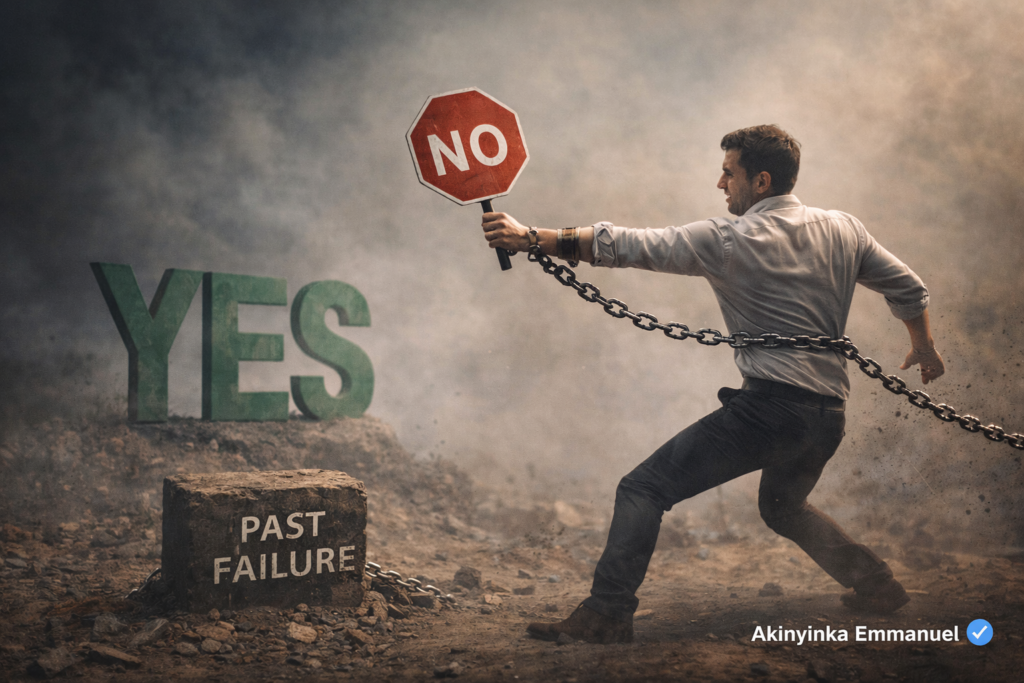
A practical guide to refusing the hold of past mistakes and choosing the next bold step even when you’re scared.
Why past failure still has power over you
Failures don’t just live in the past. They leave fingerprints on future choices; small doubts, tightened nerves, and a quieter voice that says “don’t try that again.” That whisper can stop you from starting, leading, or launching. The real cost isn’t the memory of failing; it’s the lost chance to try again.
A short story: the driving lesson that taught me more than driving
When lockdown eased in 2020, my dad had my mum and me learn to drive. Our instructor gave one simple rule: avoid accidents during training, because an accident in learning can leave a fear that never goes away.
We met a woman who had stopped after one crash in training. She believed driving wasn’t for her anymore. Later, I dented my dad’s car while reversing. It was a small accident but the shame and fear felt huge. If my instructor hadn’t pushed me back into the driver’s seat, I would have stopped. That choice to continue became the pivot.
This same pattern repeated in business: a failed venture made the next start feel riskier. The question that kept appearing was: “What if it happens again?” That question is normal. But you don’t have to let it decide for you.
Why fear gets louder the second time
Fear is often a signal, not an enemy. When it spikes before a new move, it usually means one of two things:
- You haven’t learned the true causes of the past failure.
- You’re trying to act before you’ve replaced the old story with a fresh experience.
Recognize the difference: one asks for careful work (learn), the other asks for courage (act).
Two clear steps to break free (practical & proven)
These are the exact actions I use and teach:
- Study the failure honestly (do this first)
- Write out the reasons the project failed. Be specific. Process? Timing? Team? Market fit? Execution?
- Find the root causes not excuses.
- Decide one change you will implement to prevent the same issue next time.
Why this matters: this step does ~70% of the work. Without it, you’re likely to repeat the pattern.
- Take the next step anyway (do this now)
- Make a small, concrete move that proves you tried. It should be meaningful but manageable.
- Keep the step focused on learning (a new data point) rather than perfection.
- Repeat small wins to overwrite the “I failed” story.
Why this matters: action replaces the old memory with fresh evidence. The faster you add a new result, the weaker the past becomes.
Quick checklist before you restart
- Have you listed the root causes of the last failure?
- Have you implemented at least one concrete change to prevent it?
- Is your next step small, measurable, and time-boxed?
- Do you have a backup plan that reduces downside without shrinking ambition?
How faith and grit both matter (for believers and not)
I’m a believer, and trust plays a role for me. Whether you rely on faith, logic, mentors, or steady routines, the principle is the same: believe you can try again, and pair that belief with clear action. Faith without learning or action is wishful; action without learning is reckless.
What to do next (practical action plan you can use today)
- Spend 30–60 minutes writing the failure post-mortem. Be brutal but kind.
- Pick one change (process, person, timing, offer) to implement this week.
- Schedule a small test and set a single metric to judge it.
- Share that test with one trusted person for accountability.
- After the test, log the result and iterate.
Short FAQs
Q: What if the fear never fully goes away?
A: It often won’t. The goal is not to be fearless , it’s to act despite fear. Tiny, repeated actions reduce fear’s power over time.
Q: How long before a fresh experience overrides the past?
A: No fixed time. A new meaningful result even a small win starts the rewrite immediately. Consistency shortens the timeframe.
Q: Should I tell people about my previous failure?
A: Be selective. Share what helps others learn; don’t weaponize your story. Vulnerability + insight = trust.
Final thought
Your last failure is a chapter, not the whole book. Learn from it, take one deliberate step, and give yourself the chance to rewrite the narrative. Courage is simply choosing to act with the lessons in hand.
If you try the two steps above, tell me what happened. I’d like to hear your results.
You can join me on LinkedIn: I share practical frameworks and reflections every day.